€139.15
tax excl.
€168.37
tax incl.
In stock at the Exten warehouse (delivery time: 4–8 business days)

No categories available

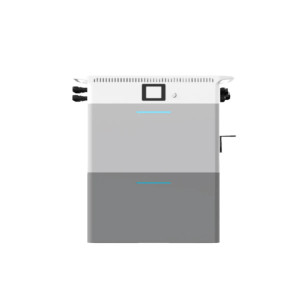
The Deye AE-F2.56 is a low-voltage (51.2 V) LiFePO4 (LFP) battery module with a rated capacity of 2.56 kWh. It is important to note: this is not an inverter, but solely an energy storage unit. It does not generate or convert electricity on its own—it requires a compatible LV inverter, typically the Deye Micro Hybrid ESS (SUN-BK series), to operate. The module’s function is to store energy; the inverter handles charge/discharge control and grid connection.
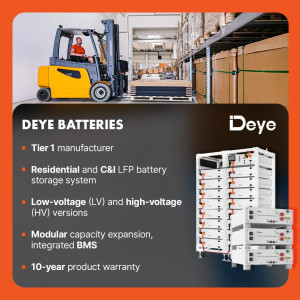
Primarily as an add-on to solar systems designed to increase residential self-consumption—it is best suited for balcony and small rooftop power plants. It works well as a backup power source in the event of a power outage, as well as for off-grid and portable installations, provided the inverter supports this functionality. Since it is modularly expandable, it also meets smaller commercial (light C&I) needs: 5 modules can be stacked vertically (12.8 kWh), and with cable connections, up to 8 clusters—a total of 40 modules (102.4 kWh)—can be connected in parallel.
The module monitors the cells via its built-in BMS and communicates with the inverter via a LoRa connection—the system automatically adjusts the charging strategy based on the storage system’s status. A single module can be charged and discharged at up to 50 A, which corresponds to approximately 2.5 kW of continuous power—exactly the amount that the paired micro-hybrid inverter can deliver. An LED display shows the charge level and any alarms. It offers flexible installation options: it can be placed on the floor or stacked on top of each other for space-saving setup.
In practice, LFP cell chemistry ensures a long service life and stable, safe operation: the module can withstand at least 6,000 cycles while retaining 70% of its capacity at the end—based on one cycle per day, this translates to well over 15 years of use. Thanks to its IP65 rating, it can be installed outdoors, and optional heating is available for temperatures below -10 °C. Due to its modular design, the system can be scaled to actual demand and expanded later without having to replace the entire unit. The package comes with a 10-year warranty, and the certifications (UN38.3, IEC 62619, CE) cover transportability and safety compliance.
This is a low-voltage (LV, 51.2 V) battery, so it works only with an inverter that has an LV input and is compatible with this voltage range—it cannot be integrated into a high-voltage (HV) system. Communication is exclusively LoRa-based, so the inverter must also support this. The power output of a single module (~2.5 kW) is tailored to the output of the micro-hybrid inverter; if more stored energy is needed, the solution is to increase the number of modules, not the inverter’s load capacity. In cold climates, it is advisable to plan for a heated version or a temperature-controlled installation site.
This is a good choice if you’re building a Deye Micro Hybrid ESS system and want to expand beyond the built-in 2.56 kWh, or if you’d like to start with a larger storage capacity from the outset. Weighing ~22 kg, its compact design and stackability make it particularly easy to handle in residential and balcony systems, while its parallel connectivity paves the way for future expansion. Its main strengths are its modular scalability and long lifespan of over 6,000 cycles—but keep in mind that it does not operate independently and must always be designed in conjunction with an inverter.
Reference: DEYE-BOS-A-PDU-2
Brand: Deye
Reference: 3U-LRACK
Brand: Deye
check_circle
check_circle